The lecture discusses relations between various Russian actors (activists, politicians, organisations, media, officials, etc.) and the Western far right. It provides a historical perspective, discussing the pro-Soviet or pro-Russian views of particular Western far right activists, but its major focus is contemporary Russia. As Moscow has become more anti-Western, contacts with the Western far right have become more intense and have operated at a high level. The lecture shows that the Russian establishment was first interested in using the Western far right to legitimise Moscow’s politics and actions both domestically and internationally, but more recently Moscow has begun to support particular far right political forces to gain leverage on European politics and undermine the liberal-democratic consensus in the West.
Showing posts with label New Right. Show all posts
Showing posts with label New Right. Show all posts
26 January 2017
Public lecture: Russia and the Western Far Right
My public lecture on the relations between various Russian actors and the Western far right at the Institute for Human Sciences (Vienna, Austria).
The lecture discusses relations between various Russian actors (activists, politicians, organisations, media, officials, etc.) and the Western far right. It provides a historical perspective, discussing the pro-Soviet or pro-Russian views of particular Western far right activists, but its major focus is contemporary Russia. As Moscow has become more anti-Western, contacts with the Western far right have become more intense and have operated at a high level. The lecture shows that the Russian establishment was first interested in using the Western far right to legitimise Moscow’s politics and actions both domestically and internationally, but more recently Moscow has begun to support particular far right political forces to gain leverage on European politics and undermine the liberal-democratic consensus in the West.
The lecture discusses relations between various Russian actors (activists, politicians, organisations, media, officials, etc.) and the Western far right. It provides a historical perspective, discussing the pro-Soviet or pro-Russian views of particular Western far right activists, but its major focus is contemporary Russia. As Moscow has become more anti-Western, contacts with the Western far right have become more intense and have operated at a high level. The lecture shows that the Russian establishment was first interested in using the Western far right to legitimise Moscow’s politics and actions both domestically and internationally, but more recently Moscow has begun to support particular far right political forces to gain leverage on European politics and undermine the liberal-democratic consensus in the West.

17 June 2016
Review of two books of Alexander Dugin
- Dugin, Alexander. Eurasian Mission: An Introduction to Neo-Eurasianism. London: Arktos, 2014. 180 pp.
- Dugin, Alexander. The Fourth Political Theory. London: Arktos, 2014. 212 pp.
- Dugin, Alexander. The Fourth Political Theory. London: Arktos, 2014. 212 pp.
 |
 |
28 November 2014
Russian fascist Aleksandr Dugin gathering intelligence on the French military
A report written by Russian fascist Aleksandr Dugin on 17 December 2013 (and published by the Anonymous International) suggests that he has been trying to gather intelligence on the French military circles.
In his report, Dugin describes a closed meeting of the French association "Civisme Défense Armée Nation" (Citizenship, Defense, Army, Nation, CiDAN) that took place at the Klingenthal castle near Strasbourg on 2-5 December 2013. CiDAN was established in 1999 by Admiral Pierre Lacoste, and, as they describe themselves, the association is guided by the "modern vision of patriotism and Europe", and promotes "devotion to the community" and contacts between civil society and the military. Its leadership largely consists of retired or reserve officers, and its president is Lieutenant Colonel Jacques Sonnet.
In his report, Dugin describes a closed meeting of the French association "Civisme Défense Armée Nation" (Citizenship, Defense, Army, Nation, CiDAN) that took place at the Klingenthal castle near Strasbourg on 2-5 December 2013. CiDAN was established in 1999 by Admiral Pierre Lacoste, and, as they describe themselves, the association is guided by the "modern vision of patriotism and Europe", and promotes "devotion to the community" and contacts between civil society and the military. Its leadership largely consists of retired or reserve officers, and its president is Lieutenant Colonel Jacques Sonnet.
8 October 2014
European far right team at the anti-Semitic conference in Tehran
On 27 September - 1 October 2014, the Iranian authorities held its annual "New Horizon" conference that hosted more than thirty participants to discuss "Zionist 9/11 conspiracy" and "Israel lobbying" in different countries.
While the anti-Semitic nature of this annual conference is nothing new, it was "surprising" to see several participants of the conference in Tehran who are supportive of Vladimir Putin's allegedly anti-fascist regime in Russia.
While the anti-Semitic nature of this annual conference is nothing new, it was "surprising" to see several participants of the conference in Tehran who are supportive of Vladimir Putin's allegedly anti-fascist regime in Russia.
 |
| Mateusz Piskorski and Thierry Meyssan, Tehran, autumn 2014 |
 |
| Claudio Mutti doing the Quennelle salute in the courtyard of the former US Embassy in Tehran, autumn 2014 |
 |
| Leonid Savin and Manuel Ochsenreiter, Tehran, autumn 2014 |
 |
| Leonid Savin and Manuel Ochsenreiter, Tehran, autumn 2014 |
15 September 2014
A rose by any other name: the World Congress of Families in Moscow
In one of my previous posts and a guest op-ed for War is Boring, I wrote that the US-based anti-LGBT hate group World Congress of Families (WCF) planned but then cancelled its annual meeting (World Congress of Families VIII) "Every Child A Gift: Large Families – The Future of Humanity". It was supposed to take place in Moscow on 10-12 September 2014. Discussing possible reasons for the cancellation of the event, I wrote:
As it often happens with the "good Christians" from various hate groups, the cancellation story was a lie. The WCF VIII did take place in Moscow on 10-11 September 2014, but had a different - yet unsurprisingly similar - name: the International Forum "Large Family and Future of Humanity".
[Following the outrageous annexation of Crimea by Putin’s Russia], the U.S. imposed sanctions on three Russian individuals — Vladimir Yakunin, Yelena Mizulina and Aleksey Pushkov — who have cooperated with WCF, among others.One organisation that had planned to take part in WCF VIII in Moscow, Concerned Women for America, pulled out for a similar reason. As its president Penny Nance said, "We made the decision that we’re not going to Russia. I don’t want to appear to be giving aid and comfort to Vladimir Putin".
Since the WCF is, above all, a U.S.-based organization, they most likely decided not to risk harming its reputation domestically by dealing with the sanctioned individuals.
As it often happens with the "good Christians" from various hate groups, the cancellation story was a lie. The WCF VIII did take place in Moscow on 10-11 September 2014, but had a different - yet unsurprisingly similar - name: the International Forum "Large Family and Future of Humanity".
1 May 2014
The Kremlin’s marriage of convenience with the European far right (in English and Russian)
The Kremlin’s marriage of convenience with the European far right
Putin’s strong-arm tactics in Eastern Ukraine and ‘moral, family-based’ policies have won him ardent support from far-right European groups. But they should not be under any illusions...
Брак по расчёту: Кремль и европейские ультраправые
Тактика применения силы в Восточной Украине и политика, ориентированная на «мораль и семейные ценности» обеспечили Путину ревностную поддержку европейских крайних правых. Но им не стоит обольщаться...
Putin’s strong-arm tactics in Eastern Ukraine and ‘moral, family-based’ policies have won him ardent support from far-right European groups. But they should not be under any illusions...
Брак по расчёту: Кремль и европейские ультраправые
Тактика применения силы в Восточной Украине и политика, ориентированная на «мораль и семейные ценности» обеспечили Путину ревностную поддержку европейских крайних правых. Но им не стоит обольщаться...
 |
| Marine Le Pen, Front National's leader, and Aleksey Pushkov, head of the Foreign Affairs Committee of the Russian Parliament, Moscow, 2013. Pushkov is now under sanctions by the US and Canada |
8 March 2014
Growing opposition to Russian Eurasianism even from the European New Right
It is hardly surprising that even some European New Right activists (not to be confused with the party-political far right) slowly start recognising the threat of Eurasianism to Europe.
Markus Willinger:
Markus Willinger:
This interview with Alexander Dugin shows us, that Russia wants, what America has. European vasalls, which follow its interest. But what do we Europeans want? Is all we can do to stand up against Washington to become then vasalls of Moskow? Or will we find the courage to form an independent europe? A Europe of fatherlands.Troy Southgate:
I support neither FEMEN nor the organised homosexual lobby, both of which have their own agendae, but I do find it rather telling that some Russians accuse their neighbours of being 'fascistic' yet applaud the fact that activists with dissenting opinions are beaten in the streets. Not to mention the fact that Ukrainians in areas containing a high percentage of Russian-speakers are also being viciously attacked. People like Dugin can whine all they like about 'fascism', but it is perfectly clear to see which set of people are really acting like neo-fascist thugs. It is to be hoped that the long-suffering Russian people will rise up and consign this oppressive regime to the dustbin of history.
28 January 2014
Italian fascist "socialists" call for the destruction of Ukraine
Former Lithuanian President Valdas Adamkus says that the European Union has betrayed Ukraine: "European Union lacks determination to support the pro-European protesters in Kiev and take retaliatory steps against Russia". Not only Ukrainians have been betrayed by the EU, of course. The same can be said about the people of Syria. Yet in both cases the Russian factor has played a crucial role.
I already wrote how the European extreme right supported the Russian imperialist agenda in relation to Ukraine. A few days ago, thanks to Giovanni Savino, an expert on Italian and historical Russian nationalisms, I have discovered yet another pro-Russian lobbying group in Italy, "Stato & Potenza", an allegedly socialist, but intrinsically fascist neo-Eurasianist sect.
I already wrote how the European extreme right supported the Russian imperialist agenda in relation to Ukraine. A few days ago, thanks to Giovanni Savino, an expert on Italian and historical Russian nationalisms, I have discovered yet another pro-Russian lobbying group in Italy, "Stato & Potenza", an allegedly socialist, but intrinsically fascist neo-Eurasianist sect.
22 December 2013
Странные друзья Юрия Збитнева и Юрия Романенко
Среди друзей Юрия Збитнева и Юрия Романенко, которые, возможно, причастны к провокациям против Украинской революции, обнаруживаются очень странные личности.
Владимир Карасев
 Проживает в Киеве. Президент
благотворительного фонда «Российско-украинское сотрудничество».
Поклонник Александра Дугина и сторонник Виктора Медведчука, которого Карасев "видит будущим лидером страны".
Проживает в Киеве. Президент
благотворительного фонда «Российско-украинское сотрудничество».
Поклонник Александра Дугина и сторонник Виктора Медведчука, которого Карасев "видит будущим лидером страны".
Владимир Карасев

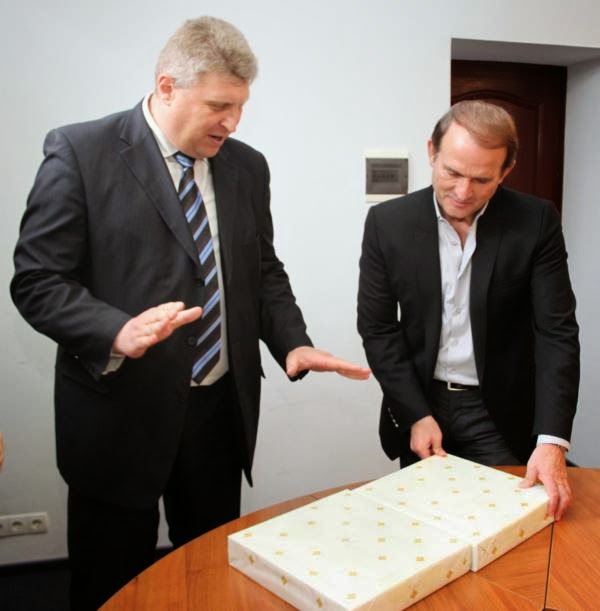 |
| Владимир Карасев и Виктор Медведчук |
20 December 2013
"Re-organisation of the Ukrainian space", or Putin's agents in Ukraine
The disgraceful publication of "There is no Ukraine" (later renamed into "Is There One Ukraine?"), where a controversial British historian (and fraudster) Orlando Figes calls for the division of Ukraine, is only only one example of an increasing trend toward implanting an idea that the division of Ukraine may solve some political problems. Viktor Yanukovych's Party of Regions discussed this idea already in 2004, during the "Orange revolution", when they held the Severodonetsk convention - a major separatist move of Yanukovych’s supporters aimed at the creation of the Sout-East Ukrainian Autonomous Republic. Present at that convention was then Moscow's Mayor Yuriy Luzhkov.
Why would Russian authorities be interested in the division of Ukraine if they want to incorporate it in its Eurasian Union? Russian fascist Aleksandr Dugin (whom I already mentioned earlier and will refer to again) believes that Ukraine is too diverse to be incorporated in its entirety in the Russian geopolitical project. In his Foundations of Geopolitics, where he describes the Russia-led Eurasian integration, Dugin writes:
Why would Russian authorities be interested in the division of Ukraine if they want to incorporate it in its Eurasian Union? Russian fascist Aleksandr Dugin (whom I already mentioned earlier and will refer to again) believes that Ukraine is too diverse to be incorporated in its entirety in the Russian geopolitical project. In his Foundations of Geopolitics, where he describes the Russia-led Eurasian integration, Dugin writes:
The sovereignty of Ukraine represents such a negative phenomenon for Russian geopolitics that it can, in principle, easily provoke a military conflict. [...] Ukraine as an independent state with some territorial ambitions constitutes an enormous threat to the whole Eurasia, and without the solution of the Ukrainian problem, it is meaningless to talk about the contitental geopolitics. [...] Considering the fact that a simple intergration of Moscow with Kyiv is impossible and will not result in a stable geopolitical structure [...], Moscow should get actively involved in the re-organisation of the Ukrainian space in accordance to the only logical and natural geopolitical model.
28 August 2013
Aleksandr Dugin and the West European New Right, 1989-1994
I've recently written a new article which inquires into the relations and contacts between Russian fascist intellectual Aleksandr Dugin and West European far right groups, first and foremost, the European New Right.
From the beginning to the mid-1990s, there was a mutual interest between Dugin and particular West European far right activists. The latter were originally interested in Dugin because he was apparently the first representative of the Russian New Right, who spoke the same language with them – both literally and intellectually – and could not only enlighten them on Russian phenomena from a native’s point of view, but also disseminate their own ideas in Russia. Furthermore, in 1992-1993, the West European far right – especially the “philo-Soviet” groups – supported the Russian “red-brown” alliance, as they were increasingly interested in political developments in Russia that could – rather feasibly – lead to a much-hoped right-wing revolution. Dugin, in his turn, originally established contacts with the West European far right in order to satisfy his interest in the contemporary interpretations of René Guénon and Julius Evola, but then he used his West European contacts to consolidate and strengthen his position in Russian ultranationalist and mainstream circles.
The article will, hopefully, be published in 2014.
 |
| Alain de Benoist, Aleksandr Dugin, Robert Steuckers. Moscow, 1992 |
The article will, hopefully, be published in 2014.
7 August 2013
Far-right Populism and Lone Wolf Terrorism in Contemporary Europe
Democracy and Security, has just published an important special issue, titled "Far-right Populism and Lone Wolf Terrorism in Contemporary Europe", which is based on the papers presented at the conference "Populist Racism in Britain and Europe since 1945" which I co-organised at the University of Northampton.
Table of contents
Introduction
Matthew Feldman & Paul Jackson
A Distant Mirror: Nineteenth-Century Populism, Nativism, and Contemporary Right-Wing Radical Politics
Hans-Georg Betz
Far-Right “Contagion” or a Failing “Mainstream”? How Dangerous Ideas Cross Borders and Blur Boundaries
Aristotle Kallis
The License to Hate: Peder Jensen's Fascist Rhetoric in Anders Breivik's Manifesto 2083: A European Declaration of Independence
Paul Jackson
Comparative Lone Wolf Terrorism: Toward a Heuristic Definition
Matthew Feldman
Au Revoir to “Sacred Cows”? Assessing the Impact of the Nouvelle Droite in Britain
Nigel Copsey
The Think Project: An Approach to Addressing Racism and Far-Right Extremism in Swansea, South Wales
Rocio Cifuentes, Geraint Rhys Whittaker & Laura Lake
Table of contents
Introduction
Matthew Feldman & Paul Jackson
A Distant Mirror: Nineteenth-Century Populism, Nativism, and Contemporary Right-Wing Radical Politics
Hans-Georg Betz
Far-Right “Contagion” or a Failing “Mainstream”? How Dangerous Ideas Cross Borders and Blur Boundaries
Aristotle Kallis
The License to Hate: Peder Jensen's Fascist Rhetoric in Anders Breivik's Manifesto 2083: A European Declaration of Independence
Paul Jackson
Comparative Lone Wolf Terrorism: Toward a Heuristic Definition
Matthew Feldman
Au Revoir to “Sacred Cows”? Assessing the Impact of the Nouvelle Droite in Britain
Nigel Copsey
The Think Project: An Approach to Addressing Racism and Far-Right Extremism in Swansea, South Wales
Rocio Cifuentes, Geraint Rhys Whittaker & Laura Lake
3 August 2013
On Aleksandr Dugin's father
I remember that, in 2009, I was the first to challenge a wide-spread assumption, or actually a myth, that Russian fascist Aleksandr Dugin's father had something to do with the military intelligence. This myth was most likely propagated by Dugin himself, in order to romanticise his own biography.
An hour of simple research, however, revealed that Dugin's father was a customs officer.
An hour of simple research, however, revealed that Dugin's father was a customs officer.
29 July 2013
Free e-prints of some of my articles
I have a number of free e-prints of my articles published with Routledge. Here they are:
"The Palingenetic Thrust of Russian Neo-Eurasianism: Ideas of Rebirth in Aleksandr Dugin's Worldview", Totalitarian Movements and Political Religions, Vol. 9, No. 4 (2008), pp. 491-506. E-print link.
Applying Roger Griffin’s methodological approach to generic fascism, the article analyses individual – socio‐political, cultural and esoteric – themes within Dugin’s doctrine, treating them as elements of a larger integral concept of rebirth that constitutes the core of Neo‐Eurasianism. The article highlights the highly syncretic nature of this ideological core, a direct result of the ‘mazeway resynthesis’ that has conditioned Dugin’s worldview. It argues that this process has been necessitated by his self‐appointed task of envisioning a new stage of history beyond Russia’s present decadent and ‘liminoid’ situation, one that he sees only coming about as the result of a ‘geopolitical revolution’. The variant of Eurasionism that results has the function of a political religion containing a powerful palingenetic thrust towards a new Russia and new West. In conclusion, it is suggested that the new order aspired to by Dugin could only be realised by establishing a totalitarian regime.
"The Palingenetic Thrust of Russian Neo-Eurasianism: Ideas of Rebirth in Aleksandr Dugin's Worldview", Totalitarian Movements and Political Religions, Vol. 9, No. 4 (2008), pp. 491-506. E-print link.
Applying Roger Griffin’s methodological approach to generic fascism, the article analyses individual – socio‐political, cultural and esoteric – themes within Dugin’s doctrine, treating them as elements of a larger integral concept of rebirth that constitutes the core of Neo‐Eurasianism. The article highlights the highly syncretic nature of this ideological core, a direct result of the ‘mazeway resynthesis’ that has conditioned Dugin’s worldview. It argues that this process has been necessitated by his self‐appointed task of envisioning a new stage of history beyond Russia’s present decadent and ‘liminoid’ situation, one that he sees only coming about as the result of a ‘geopolitical revolution’. The variant of Eurasionism that results has the function of a political religion containing a powerful palingenetic thrust towards a new Russia and new West. In conclusion, it is suggested that the new order aspired to by Dugin could only be realised by establishing a totalitarian regime.
13 May 2013
Conference: Fascist Ideologues Past and Present, Teesside University, 4-5 July 2013
Conference: Fascist Ideologues Past and Present
Teesside University
4-5 July 2013
This groundbreaking conference will present a variety of perspectives on leading fascist and far-right ideologues. Focussing upon the historical impact and contemporary influence of key radical right figures and 'intellectual' trends, such as transnationalism, metapolitics and White Power music, this event promises to bring together cutting-edge themes and speakers over two days of academic discussion.
With contributions ranging from internationally-renowned researchers to British postgraduates, this event is intended to serve several purposes: to examine the continuities and changes to (neo-)fascist ideology over the last century; to present reports and interviews on key aspects of the contemporary far-right – especially regarding the turn toward anti-Muslim prejudice and responses to Britain's PREVENT strategy – and more generally, to formally launch the UK's first research centre dedicated to these issues: the Centre for Fascist, Anti-fascist and Post-fascist studies at Teesside University.
Teesside University
4-5 July 2013
This groundbreaking conference will present a variety of perspectives on leading fascist and far-right ideologues. Focussing upon the historical impact and contemporary influence of key radical right figures and 'intellectual' trends, such as transnationalism, metapolitics and White Power music, this event promises to bring together cutting-edge themes and speakers over two days of academic discussion.
With contributions ranging from internationally-renowned researchers to British postgraduates, this event is intended to serve several purposes: to examine the continuities and changes to (neo-)fascist ideology over the last century; to present reports and interviews on key aspects of the contemporary far-right – especially regarding the turn toward anti-Muslim prejudice and responses to Britain's PREVENT strategy – and more generally, to formally launch the UK's first research centre dedicated to these issues: the Centre for Fascist, Anti-fascist and Post-fascist studies at Teesside University.
8 November 2010
The resurgence of radical conservatism in Russia
Professor Bill Bowring (Birkbeck, University of London and Visiting Professor in Law at the University of Northampton) will deliver a lecture -
The Resurgence of Radical Conservatism in Russia and the Theory and Practice of Human Rights Protection
The lecture will take place at the University of Northampton (Brampton 18 Park Campus), on 1 December 2010, at 6pm.
For further information -
E-mail: Melanie.crofts@northampton.ac.uk
Tel.: (01604)-892124
All welcome!
The Resurgence of Radical Conservatism in Russia and the Theory and Practice of Human Rights Protection
The lecture will take place at the University of Northampton (Brampton 18 Park Campus), on 1 December 2010, at 6pm.
For further information -
E-mail: Melanie.crofts@northampton.ac.uk
Tel.: (01604)-892124
All welcome!
28 September 2010
Who Makes the Nazis?
This blog is highly recommended -
Who Makes the Nazis?
Keeping an eye on the neo-fascists burrowing their way into a subculture near you
(Just in case you don't know: "Who Makes the Nazis?" is a title of one of the Fall's songs.)
Who Makes the Nazis?
Keeping an eye on the neo-fascists burrowing their way into a subculture near you
Who Makes the Nazis? is a site focused on the fascist presence in various 'transgressive' (by their own estimation) musical subcultures. The claim is that at the fringes of these milieus, ideas about the sanctity of art and the irresponsibility and fundamental 'amorality' of the artist provide perfect cover behind which fascist and pro-fascist ideologues are allowed to spread their ideas. Currently these cultures include 'post-industrial', 'martial', 'neo-folk', 'apocalyptic folk' and 'darkwave', among others. It is not a matter of condemning these subcultures, which in fact contain many non-fascist, liberal, socialist, anti-fascist, etc., supporters, but rather of drawing a clear line between the fascists and non-fascists within them by showing the latter the nature and extent of the problem, in the hope that they will themselves marginalise and ultimately reject fascist participation in their 'scene'.
(Just in case you don't know: "Who Makes the Nazis?" is a title of one of the Fall's songs.)
11 February 2010
Russian Nationalism Yahoo group
In September 2007 Andreas Umland established a Russian Nationalism group on Yahoo groups.
Although you can freely see the messages, Links and Files sections are available only for the members of the group. Joining is pretty easy and you are not required to have a Yahoo account.
The group is designed as a forum of exchange and an open archive serving researchers, journalists and others interested in the history and current permutations of Russian right-wing thought and politics. While everybody is invited to join, this forum is reserved for the spread of substantive, analytical information as well as for the announcement on relevant conferences, publications, and other academic projects. This is not a discussion group.
In addition to extremely useful Links and Files sections, there is also a biweekly "Russian Nationalism Bulletin" (RNB) that has started to appear on 1 November 2007.
Although you can freely see the messages, Links and Files sections are available only for the members of the group. Joining is pretty easy and you are not required to have a Yahoo account.
4 February 2010
The Palingenetic Thrust of Russian Neo-Eurasianism
A new issue of Russian-language version of German online academic journal Forum für osteuropäische Ideen- und Zeitgeschichte features my article on Aleksandr Dugin -
Палингенетический проект неоевразийства: идеи возрождения в мировоззрении Александра Дугина
It was previously published in Totalitarian Movements and Political Religions and is available here.
The new issue of Forum also features important articles by Andreas Umland, Marina Peunova, Marlene Laruelle, Leonid Luks and other authors.
Палингенетический проект неоевразийства: идеи возрождения в мировоззрении Александра Дугина
It was previously published in Totalitarian Movements and Political Religions and is available here.
The new issue of Forum also features important articles by Andreas Umland, Marina Peunova, Marlene Laruelle, Leonid Luks and other authors.
21 January 2010
Von Thronstahl: Germanium Metallicum
I hate that Von Thronstahl released their new album Germanium Metallicum after I had written my article on apoliteic music!

There is an interesting text in the booklet accompanying the above-mentioned album -
(Small wonder that a Russian New Right groupuscule "Peoples' Rights" has published a lengthy review of Germanium Metallicum on their web-site.)
I would have definitely quoted this text in my article, as it is such a revealing example of the far-right inner immigration! And, speaking of the inner immigration: Von Thronstahl is citing George Orwell in the same booklet: in its turn, that is a nice example of the far right's habitual appropriation of the left-wing legacy -
What would have Orwell said....

There is an interesting text in the booklet accompanying the above-mentioned album -
This album is the result of a collaboration between young artists from seven countries - united in their creative will, and conspired by their apprehension for their Europe, which should be both a home and a fortress for their culture and their children.
Protecting their holy values, a young generation of Europeans are about to strengthen the resistance against all forms of imminence: both from the outside and from the inside. And, if necessary, even against their own governments, for now they betray the essential interests of their people.
Pure and noble are the hearts of young idealists, pure and noble is the element of Germanium Metallicum. The homeopathic effects of this Germanium Metallicum is also helping to vitalise the power of resistance and it makes contact with the inner will and determination. So this is a worthy symbol for an alchemic transformation; physically and spiritually.
(Small wonder that a Russian New Right groupuscule "Peoples' Rights" has published a lengthy review of Germanium Metallicum on their web-site.)
I would have definitely quoted this text in my article, as it is such a revealing example of the far-right inner immigration! And, speaking of the inner immigration: Von Thronstahl is citing George Orwell in the same booklet: in its turn, that is a nice example of the far right's habitual appropriation of the left-wing legacy -
Being in a minority, even a minority of one, did not make you mad. There was truth and there was untruth, and if you clung to the truth even against the whole world, you were not mad.
(George Orwell, 1984).
What would have Orwell said....
Subscribe to:
Posts (Atom)