I am proud to announce the publication of two important books in the "Explorations of the Far Right" book series that I edit for ibidem Press: British Fascism: A Discourse-Historical Analysis by John E. Richardson and The Hungarian Far Right: Social Demand, Political Supply, and International Context by Péter Krekó and Attila Juhász.
John E. Richardson, British Fascism: A Discourse-Historical Analysis (Stuttgart: ibidem Press, 2017)
Fascism is inherently duplicitous, claiming one thing whilst being committed to something else. In examining this dishonesty, it is essential to distinguish between the surface arguments in fascist discourse and the underlying ideological commitments. Analyzing contemporary fascism is particularly difficult, since no fascist party admits to being fascist. Drawing on the critical insights of historical and linguistic research, this book offers an original and discerning approach to the critical analysis of fascism. It demonstrates that any understanding of the continuing popularity of fascist political ideology requires interdisciplinary analysis which exposes the multiple layers of meanings within fascist texts and the ways they relate to social and historic context. It is only through contextualization we can demonstrate that when fascists echo concepts and arguments from mainstream political discourse (e.g. 'British jobs for British workers') they are not being used in the same way.
Péter Krekó, Attila Juhász, The Hungarian Far Right: Social Demand, Political Supply, and International Context (Stuttgart: ibidem Press, 2017)
This timely book examines far-right politics in Hungary—but its relevance points much beyond Hungary. With its two main players, the radical right Jobbik and populist right Fidesz, it is at the same time an Eastern European, European, and global phenomenon. Jobbik and Fidesz, political parties with a populist, nativist, authoritarian approach, Eastern and pro-Russian orientation, and strong anti-Western stance, are on the one hand products of the problematic transformation period that is typical for post-communist countries. But they are products of a "populist zeitgeist" in the West as well, with declining trust in representative democratic and supranational institutions, politicians, experts, and the mainstream media. The rise of politicians such as Nigel Farage in the U.K., Marine Le Pen in France, Norbert Hofer in Austria, and, most notably, Donald Trump in the U.S. are clear indications of this trend. In this book, the story of Jobbik (and Fidesz), contemporary players of the Hungarian radical right scene, are not treated as separate case studies, but as representatives of broader international political trends. Far-right parties such as Jobbik (and increasingly Fidesz) are not pathologic and extraordinary, but exaggerated, seemingly pathological manifestations of normal, mainstream politics. The radical right is not the opposite and denial of the mainstream, but the sharp caricature of the changing national, and often international mainstream.
Showing posts with label fascism. Show all posts
5 June 2017
21 April 2017
Marine Le Pen Is No Patriot of France
In the beginning of the 1980s, Belgian post-war neo-fascist ideologue Jean Thiriart wrote that he wanted to see the formation of a Euro-Soviet Empire, a fascist-communist super-state that would stretch from Vladivostok to Dublin. He believed that Moscow could “make Europe European” as an antithesis to what believed was an Americanised Europe, and was ready for “total collaboration” with the Soviet Union.
He was no stranger to “total collaboration”, as he served in the Waffen SS in the 1940s and was convicted for his collaborationism with the Third Reich after the war, but in the 1980s he would swear allegiance to a different totalitarian regime: “I will then be the first to put a red star on my cap. Soviet Europe, yes, without reservations”.
Thiriart’s dreams never came true, but he has followers who would collaborate with the authoritarian regime of Vladimir Putin who, they believe, would also “make Europe European”. These are extreme right activists and politicians who see in Putin’s Russia “a bastion of traditional values” and “a beacon of hope” in their fight against liberalism and united Europe.
He was no stranger to “total collaboration”, as he served in the Waffen SS in the 1940s and was convicted for his collaborationism with the Third Reich after the war, but in the 1980s he would swear allegiance to a different totalitarian regime: “I will then be the first to put a red star on my cap. Soviet Europe, yes, without reservations”.
Thiriart’s dreams never came true, but he has followers who would collaborate with the authoritarian regime of Vladimir Putin who, they believe, would also “make Europe European”. These are extreme right activists and politicians who see in Putin’s Russia “a bastion of traditional values” and “a beacon of hope” in their fight against liberalism and united Europe.
20 April 2017
Marine Le Pen n’hésiterait pas à rendre la France dépendante de la Russie
Au début des années 1980, Jean Thiriart (1922-1992), un idéologue néofasciste belge d’après-guerre, appelait de ses vœux la création d’un empire eurosoviétique, un super-Etat fascisto-communiste qui s’étendrait de Vladivostok à Dublin. Il était convaincu que Moscou pouvait « faire l’Europe européenne » comme antithèse à ce qu’il jugeait être l’Europe américanisée, et prônait « la collaboration totale » avec l’Union soviétique.
La collaboration totale, il connaissait, puisqu’il s’était enrôlé dans la Waffen SS dans les années 1940, ce qui lui avait valu d’être condamné à la Libération. Dans les années 1980, il allait prêter allégeance à un autre régime totalitaire : « Je serai alors le premier à mettre une étoile rouge sur ma casquette. L’Europe soviétique, oui sans réticence ».
Les rêves de Thiriart ne se sont jamais concrétisés, mais l’homme a des disciples prêts à collaborer avec le régime autoritaire de Vladimir Poutine qui, selon eux, veut aussi « faire l’Europe européenne ». Ce sont des militants et politiciens d’extrême droite qui voient dans la Russie de Poutine « un bastion des valeurs traditionnelles » et une « lueur d’espoir » dans leur combat contre le libéralisme et l’Europe unie.
La collaboration totale, il connaissait, puisqu’il s’était enrôlé dans la Waffen SS dans les années 1940, ce qui lui avait valu d’être condamné à la Libération. Dans les années 1980, il allait prêter allégeance à un autre régime totalitaire : « Je serai alors le premier à mettre une étoile rouge sur ma casquette. L’Europe soviétique, oui sans réticence ».
Les rêves de Thiriart ne se sont jamais concrétisés, mais l’homme a des disciples prêts à collaborer avec le régime autoritaire de Vladimir Poutine qui, selon eux, veut aussi « faire l’Europe européenne ». Ce sont des militants et politiciens d’extrême droite qui voient dans la Russie de Poutine « un bastion des valeurs traditionnelles » et une « lueur d’espoir » dans leur combat contre le libéralisme et l’Europe unie.
4 April 2017
Russia and the Western Far Right: Tango Noir (pre-order)
My forthcoming book Russia and the Western Far Right: Tango Noir is now available for pre-order via Routledge or via several Amazon websites: France, Italy, Spain, UK, Canada, Japan, US, India.
Description:
The growing influence on the Western far right has been much discussed in the media recently. This book is the first detailed inquiry into what has been a neglected but critically important trend: the growing links between Russian actors and Western far right activists, publicists, ideologues, and politicians. The author uses a range of sources including interviews, video footage, leaked communications, official statements and press coverage in order to discuss both historical and contemporary Russia in terms of its relationship with the Western far right.
Initial contacts between Russian political actors and Western far right activists were established in the early 1990s, but these contacts were low profile. As Moscow has become more anti-Western, these contacts have become more intense and have operated at a higher level. The book shows that the Russian establishment was first interested in using the Western far right to legitimise Moscow’s politics and actions both domestically and internationally, but more recently Moscow has begun to support particular far right political forces to gain leverage on European politics and undermine the liberal-democratic consensus in the West.
Contributing to ongoing scholarly debates about Russia’s role in the world, its strategies aimed at securing legitimation of Putin’s regime both internationally and domestically, modern information warfare and propaganda, far right politics and activism in the West, this book draws on theories and methods from history, political science, area studies, and media studies and will be of interest to students, scholars, activists and practitioners in these areas.
15 August 2016
The Far Right Front of Russian Active Measures in Europe
The relations between Russia and the European far right is not a new phenomenon, but they acquired particular salience in the recent few years, especially after the Russian annexation of Crimea and the start of the Russian invasion of Eastern Ukraine.
Tactical collaboration with the European, especially German, extreme right characterised even the Cold War period of Russian history despite the horrors of the Second World War and the Soviet Union’s official condemnation of fascism. One example of Soviet collaboration with the German extreme right is the Soviet financial support for the extreme right neutralist movement in West Germany in the beginning of the 1950s. That period was marked by the beginning of the Cold War, and, in its struggle against the West, the Soviets employed a broad range of what they called “active measures” – actions comprising of establishing espionage rings in Western societies, spreading disinformation among Western publics, buying political influence, supporting socialist and communist parties, infiltrating Western peace movements, etc. The beginning of the 1950s was also a period in which West German political elites discussed a prospect of their country joining NATO. The Soviets opposed such a development and supported not only left-wing organisations in West Germany, but also extreme right neutralist movements that also opposed NATO membership.
17 June 2016
Review of two books of Alexander Dugin
- Dugin, Alexander. Eurasian Mission: An Introduction to Neo-Eurasianism. London: Arktos, 2014. 180 pp.
- Dugin, Alexander. The Fourth Political Theory. London: Arktos, 2014. 212 pp.
19 May 2016
Pro-Russian activism of Mateusz Piskorski detained in Poland
On May 18-19, 2016, the media reported that Poland's Internal Security Agency searched the homes of the leaders of the pro-Russian party Zmiana: Tomasz Jankowski, Konrad Rękas, and Mateusz Piskorski. It was also reported in the media – and then confirmed by Zmiana – that Piskorski was detained by the Polish authorities. Few details are currently available on the case, but it may be useful to review some of Piskorski's political activities.
In the late 1990s, Mateusz Piskorski was an active member of the Niklot Association for Tradition and Culture, a neo-pagan, “metapolitical fascist” group that was influenced by the ideology of Zadruga, the Polish inter-war neo-pagan fascist movement. Apart from the indigenous Polish inter-war influences, Niklot was inspired by völkisch ideology, the writings of Italian fascist Julius Evola and French New Right thinker Alain de Benoist. The group was also characterized by its Slavic ultranationalism and opposed “the intermixture of cultures, languages, peoples and races”. Niklot published neo-Nazi zines Odala and Wadera, and actively recruited its members from skinhead and National Socialist Black Metal subcultures. The following quote from one of Odala’s articles provides a telling glimpse into the ideology of Niklot:
The neo-pagan, pro-Slavic world-view became an ideological link between Polish and Russian neo-Nazis. By invitation of Pavel Tulaev, head of the Russia-based far right Cultural Exchange Association, former co-editor of the journal Nasledie Predkov and co-editor of the neo-pagan racist journal Ateney, Piskorski and Niklot’s Marcin Martynowski, as well as members of other Polish neo-Nazi groups, paid their first visit to Russia in August 2000.
In the late 1990s, Mateusz Piskorski was an active member of the Niklot Association for Tradition and Culture, a neo-pagan, “metapolitical fascist” group that was influenced by the ideology of Zadruga, the Polish inter-war neo-pagan fascist movement. Apart from the indigenous Polish inter-war influences, Niklot was inspired by völkisch ideology, the writings of Italian fascist Julius Evola and French New Right thinker Alain de Benoist. The group was also characterized by its Slavic ultranationalism and opposed “the intermixture of cultures, languages, peoples and races”. Niklot published neo-Nazi zines Odala and Wadera, and actively recruited its members from skinhead and National Socialist Black Metal subcultures. The following quote from one of Odala’s articles provides a telling glimpse into the ideology of Niklot:
Considering the decay and multiraciality of the West, only a united Slavdom -- the northern empire of the rising sun -- is the hope for the White Race and anyone in the West who does not support the Slavs betrays the White Race and himself.
The neo-pagan, pro-Slavic world-view became an ideological link between Polish and Russian neo-Nazis. By invitation of Pavel Tulaev, head of the Russia-based far right Cultural Exchange Association, former co-editor of the journal Nasledie Predkov and co-editor of the neo-pagan racist journal Ateney, Piskorski and Niklot’s Marcin Martynowski, as well as members of other Polish neo-Nazi groups, paid their first visit to Russia in August 2000.
![]() |
| Polish neo-Nazis visiting Moscow in August 2000. Piskorski is in the center, together with his girlfriend |
11 February 2016
Human rights situation in Crimea: A brief analysis of the EP vote
On 3 February 2016, the European Parliament adopted a resolution "on the human rights situation in Crimea, in particular of the Crimean Tatars". The resolution reminds that "the Russian Federation has illegally annexed Crimea and Sevastopol and therefore violated international law, including the UN Charter, the Helsinki Final Act, the 1994 Budapest Memorandum and the 1997 Treaty of Friendship, Cooperation and Partnership between the Russian Federation and Ukraine".
Essentially, the European Parliament "reiterates its strong commitment to the sovereignty and territorial integrity of Ukraine within its internationally recognised borders" and "calls on Russia to start negotiations with Ukraine and other parties on the de-occupation of Crimea".
25 January 2016
How Alexander Dugin's Neo-Eurasianists geared up for the Russian-Ukrainian war in 2005-2013
The Neo-Eurasianist perspective on Ukraine was formed already in the 1990s, when Russian fascist Alexander Dugin argued, in his Foundations of Geopolitics, that Ukraine was “an unnatural state” consisting of four major regions with allegedly different geopolitical loyalties, and that a sovereign and united Ukraine constituted a major threat to the geopolitical security of Russia and the envisioned Eurasian Empire.
Dugin specified the means for neutralising the "Ukrainian threat to Russia" in 2009 in his book The Fourth Political Theory. In particular, he argued that “extending Russian influence on the post-Soviet space” would not necessarily imply “direct colonisation in the old tradition”: “in our world, more sophisticated and efficient network technologies are developed that allow to achieve the same results with the different means – with the use of information resources, social organisations, faith-based groups, and social movements”. However, Russia’s direct action was also possible:
It cannot be excluded that a battle for Crimea and Eastern Ukraine awaits us.
Only a short time ago, the most hot-headed among the Russian hawks presumed only an internal conflict in Ukraine, as well as political, economic and energy pressure [on Ukraine] from the Russian side, but now a possibility of a direct military clash no longer appears unrealistic.
19 September 2015
Russian fascist militants give money to Swedish counterparts
One of the previous posts addressed the issue of two Russian far right organisations, namely the Rodina party and the Russian Imperial Movement (Russkoe Imperskoe Dvizhenie, RID), engaged in building of an international extreme right network under the title “World National-Conservative Movement” (WNCM). According to its political programme, the WNCM - rather than being just a framework for conferences - is focused on action.
A few days ago, new information has emerged that further corroborates this argument. On 5-6 September 2015, representatives of the RID visited Sweden and took part in a meeting of the Swedish fascist organisation Nordic Resistance (Nordiska Motståndsrörelsen), which was invited to join the WNCM earlier. During his talk, the RID's leader Stanislav Vorobyov, warned about "a full-scale war against the traditional values of Western civilisation" and explained that the uniform in which he showed up at the meeting was a symbol of their fight against "the Jewish oligarchs in Ukraine" on the side of pro-Russian extremists in Eastern Ukraine. Furthermore, he claimed that "the Zionist strategy in the Middle East would be used int he future to divide and rule the nations of Europe".
![]() |
| Stanlislav Vorobyov, the leader of the Russian Imperial Movement, speaking at the meeting of the "Nordic Resistance", 5/6 September 2015 |
15 September 2015
Russian politicians building an international extreme right alliance
(This article originally appeared in Norwegian in Verdens Gang.)
Russia seems to be getting serious about building an international alliance of extreme right parties that would aim at undermining the liberal democratic consensus in the West. In addition to providing financial support for parties such as France’s Front National and using extreme right activists and politicians as tools of propaganda, Russia is now building what it calls the “World National-Conservative Movement” (WNCM). A number of the internal documents (passed to me by the Moscow-based "Sova Centre") provide an insight into the agenda and structure of the WNCM.
![]() |
| The logo of the World National Conservative Movement |
17 July 2015
A new book: Eurasianism and the European Far Right
Lexington Books published a volume Eurasianism and the European Far Right: Reshaping the Europe-Russia Relationship edited by Marlène Laruelle, to which I contributed two chapters.
6 July 2015
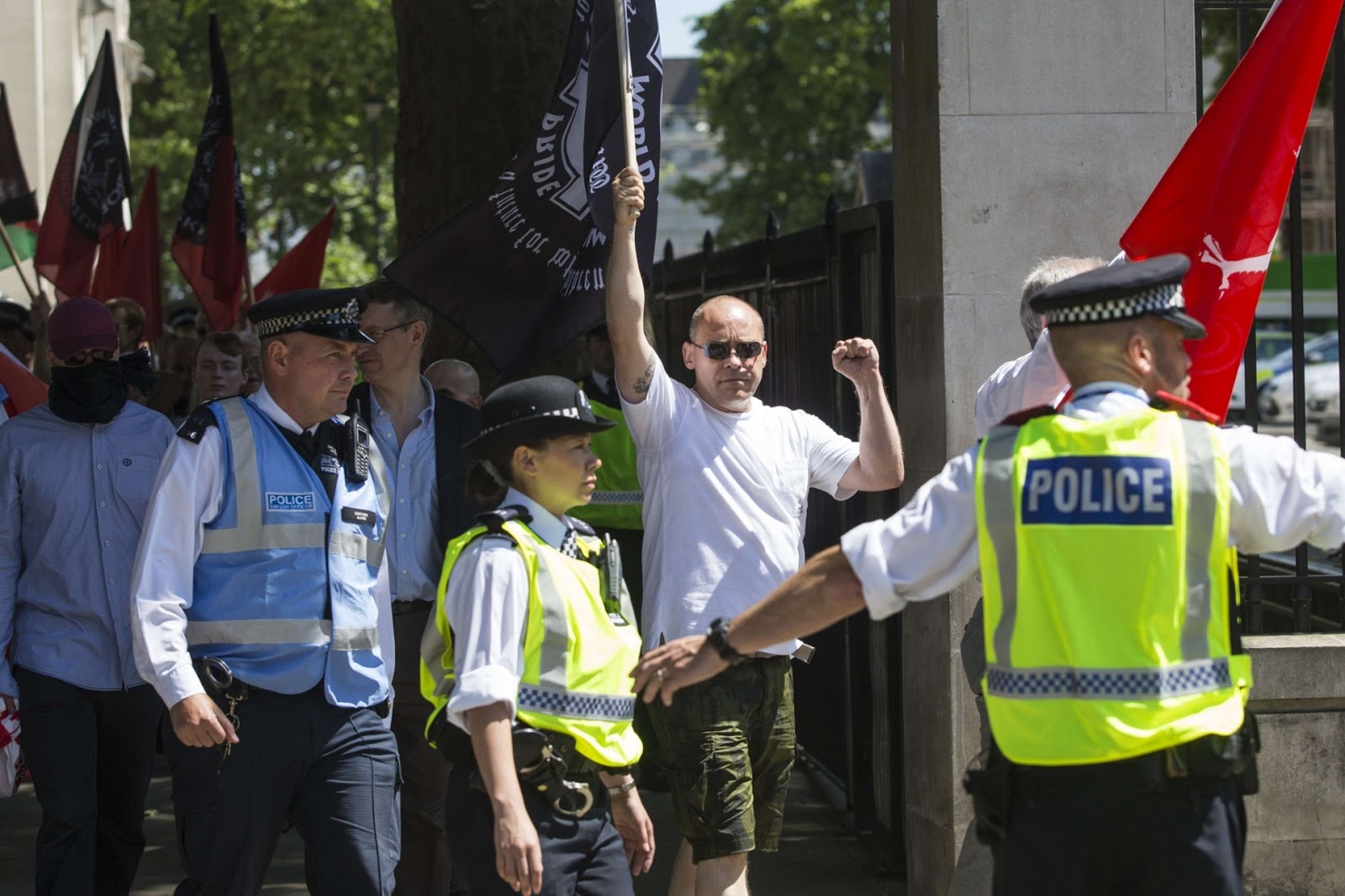
The anti-Semitic demo in London - a Moscow's KGB-style psy-op?
As the readers of this blog perfectly know, the Kremlin is actively cooperating - sometimes financially - with European far right parties. However, Moscow may also be engaged in even more sinister activities, namely whipping up racial hatred in the West in order to discredit democratic societies that have taken a strong position on sanctions against Russia for its war on Ukraine.
While it cannot be conclusively proven yet, the "anti-Jewification" demonstration that took place in London on 4 July might be an example of such activities. At least, there are sound reasons to suspect exactly this.
The demonstration was organised by the neo-Nazi Eddy Stampton who is notorious for drunken violence towards women, and was attended, among others, by his neo-Nazi mate Piers Mellor; the head of the far right IONA London Forum Jeremy "Jez" Bedford-Turner; and Britain-based activists of the Polish fascist National Revival of Poland (Narodowe Odrodzenie Polski).
While it cannot be conclusively proven yet, the "anti-Jewification" demonstration that took place in London on 4 July might be an example of such activities. At least, there are sound reasons to suspect exactly this.
The demonstration was organised by the neo-Nazi Eddy Stampton who is notorious for drunken violence towards women, and was attended, among others, by his neo-Nazi mate Piers Mellor; the head of the far right IONA London Forum Jeremy "Jez" Bedford-Turner; and Britain-based activists of the Polish fascist National Revival of Poland (Narodowe Odrodzenie Polski).
![]() |
| Violent neo-Nazi Eddy Stampton leading the demonstration, 4 July 2015, London. Photo: Jack Taylor/AFP/Getty Images |
10 June 2015
State of EU-Russia relations: A brief analysis of the EP vote
On 10 June 2015, the European Parliament adopted a resolution "on the state of EU-Russia relations". It is a strong resolution that condemns the illegal annexation of Crimea and Russia's war against Ukraine, as well as reminding that Russia is "directly or indirectly, involved in a number of 'frozen conflicts' in
its neighbourhood – in Transnistria, South Ossetia, Abkhasia and Nagorno
Karabakh".
Importantly, the resolution states that "at this point Russia [...] can no longer be treated as, or considered, a ‘strategic partner’".
In the context of this blog, I am happy to say that the European Parliament raises concerns directly related to the themes regularly discussed here, namely the cooperation between Putin's Russia and the Western far right:
Importantly, the resolution states that "at this point Russia [...] can no longer be treated as, or considered, a ‘strategic partner’".
In the context of this blog, I am happy to say that the European Parliament raises concerns directly related to the themes regularly discussed here, namely the cooperation between Putin's Russia and the Western far right:
Is deeply concerned at the ever more intensive contacts and cooperation, tolerated by the Russian leadership, between European populist, fascist and extreme right-wing parties on the one hand and nationalist groups in Russia on the other; recognises that this represents a danger to democratic values and the rule of law in the EU; calls in this connection on the EU institutions and Member States to take action against this threat of an emerging ‘Nationalist International’;
Is deeply concerned with Russia´s support for and financing of radical and extremist parties in the EU Member States; considers a recent meeting in St Petersburg of the far right parties an insult to the memory of millions of Russians who sacrificed their lives to save the world from Nazism;
7 June 2015
Sergey Glazyev and the American fascist cult
Among Russian politicians who established relations with the Western far right already in the 1990s, Sergey Glazyev, currently an adviser to Russian President Vladimir Putin on the issues of regional economic integration, is one of the most prominent.
In 1992-1993, Glazyev was Minister of External Economic Relations of the Russian Federation, but resigned in protest over the decision of contemporary president Boris Yeltsin to dissolve the State Duma (Russian parliament) – the decision that resulted in the unsuccessful coup attempt staged by then vice president Aleksandr Rutskoy and then chairman of the Duma Ruslan Khasbulatov in October 1993 in Moscow. Glazyev was elected to the Duma in 1994 and became the chairman of the parliamentary Economic Affairs Committee.
![]() |
| Sergey Glazyev |
29 May 2015
"Putin's fascist Russia?" Roger Griffin's comments on the concept
Several authors argue that either Putin's Russia is already a fascist state or Putin is building one. Some of the most recent articles arguing along this line can be found here:
Alexander J. Motyl: Is Vladimir Putin a Fascist?
Rob Garver: Putin Isn’t Reviving the USSR, He’s Creating a Fascist State
Here I post a few comments from Professor Roger Griffin, the world's leading expert on fascism and the founder of the New Consensus school within Fascism Studies.
Alexander J. Motyl: Is Vladimir Putin a Fascist?
Rob Garver: Putin Isn’t Reviving the USSR, He’s Creating a Fascist State
Here I post a few comments from Professor Roger Griffin, the world's leading expert on fascism and the founder of the New Consensus school within Fascism Studies.
1 April 2015
What does the fascist conference in St. Petersburg tell us about contemporary Russia?
On the 9th of May, Russia will plunge into ritualised mass celebrations to commemorate the 70th anniversary of the victory over fascism in the “Great Patriotic War”. At the same time, on the 22nd of March, a few weeks before the celebrations, a Russian party with a presumably patriotic name “Motherland” held the International Russian Conservative Forum (IRCF) that hosted over a dozen of notorious European and American fascists, white supremacists and anti-Semites.
To add injury to the apparent insult, the Motherland party held the IRCF in St. Petersburg that suffered, in 1941-1944, one of the longest sieges in the military history (Siege of Leningrad) that resulted in over a million casualties of civilians alone.
Is this (yet another) case of Russia’s ideological schizophrenia or something else?
To add injury to the apparent insult, the Motherland party held the IRCF in St. Petersburg that suffered, in 1941-1944, one of the longest sieges in the military history (Siege of Leningrad) that resulted in over a million casualties of civilians alone.
Is this (yet another) case of Russia’s ideological schizophrenia or something else?
10 March 2015
The far right "International Russian Conservative Forum" to take place in Russia
The Russian fascist Rodina (Motherland) party that was founded by Russia's current Deputy Prime Minister Dmitry Rogozin is organising a large conference titled "International Russian Conservative Forum" (IRCF) to be held in St. Petersburg on 22 March 2015.
19 February 2015
German Die Linke delegation visits right-wing terrorists in Eastern Ukraine
Just two weeks after the leader of the pro-Russian right-wing terrorist organisation "Donetsk People's Republic" (DNR) Aleksandr Zakharchenko declared that Ukraine was run by "miserable Jews", a delegation of the German party Die Linke visited the author of this anti-Semitic jibe and delivered what they called "humanitarian help".
![]() |
| Pro-Russian right-wing terrorist Aleksandr Zakharchenko (2nd from the left) and the delegation of Die Linke: Wolfgang Gehrcke (3rd) and Andrej Hunko (4th), Donetsk, 16 February 2015 |
29 January 2015
On the statement of the University of Piraeus regarding Kotzias and Dugin
Following the publications in this blog and elsewhere about the contacts between current Greek Foreign Minister Nikos Kotzias and Russian fascist Aleksandr Dugin, Professor Angel Kotios, speaking on behalf of the University of Piraeus, has issued a statement in which he has tried to distance from Dugin. In particular, the statement says:
With relation to the negative reports referred to a lecture by Professor Aleksandr Dugin at the University of Piraeus and in particular the Department of International and European Studies, as Dean of the Faculty of Economics, Business and International Studies, I would like to clarify the following:Anyone who is more or less familiar with the academic practice, knows that a lecturer cannot simply "invite himself" to give a paper in a course of another lecturer. Even if this were the case, then Kotzias had to check the background of the intrusive lecturer and eventually reject to have Dugin at the University of Piraeus. He did not reject. However, this was not the case at all, and the transcript of the lecture confirms that Dugin was invited.
The lecture by Professor Dugin held on 12 April 2013 as part of the course "The Foreign Policy of Russia" with tutor Professor N. Kotzias, and it took place after a proposal of Mr. Dugin himself, via his collaborators, and, therefore, in no case was he invited by Professor Kotzias.
Subscribe to:
Posts (Atom)